




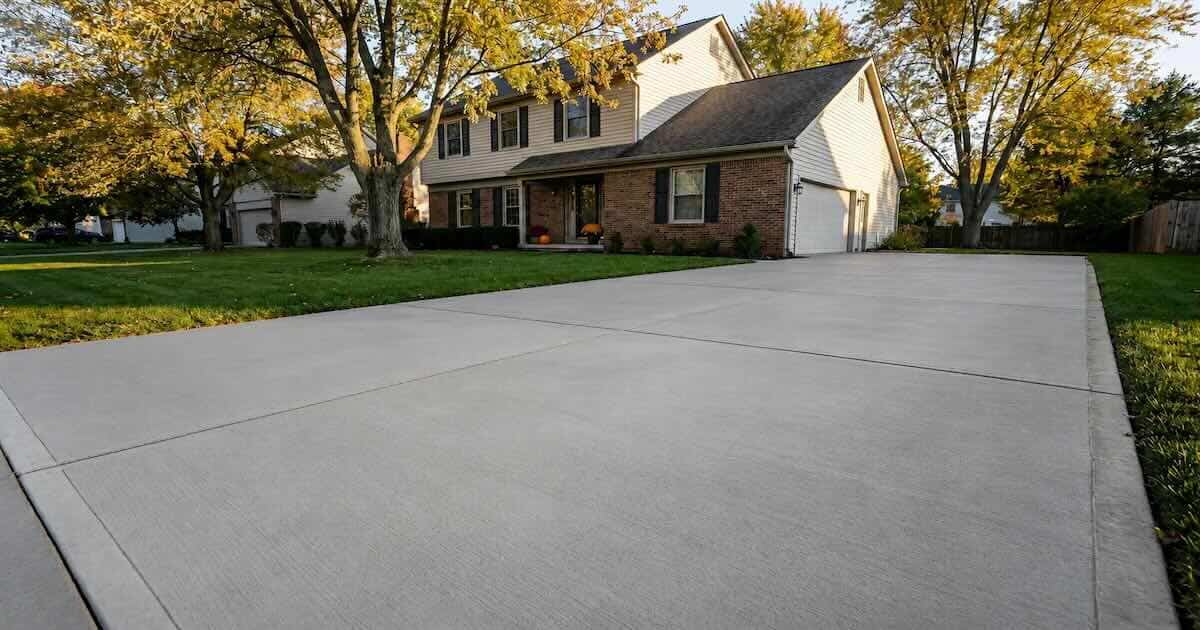
The best time to seal a driveway in Central Indiana is late May through early October, when daytime temps hold above 50°F and no rain is forecast for 24 hours. For a brand-new concrete driveway, wait at least 28 days after the pour before sealing. If your driveway has never been sealed and it's already a few years old, the right time is now — before the next freeze-thaw cycle does more damage.
There's a lot of bad timing advice floating around for driveway sealing. Some of it comes from big-box retailers who want you to seal every fall (and buy more sealer). Some of it comes from articles written for the wrong climate. Indiana isn't Florida, and it isn't Minnesota — our freeze-thaw window, humidity, and salt season are their own thing.
By the end of this guide, you'll know:
- The best months to seal a driveway in Central Indiana
- How long to wait before sealing new concrete
- How often you should re-seal (the honest answer)
- Why timing matters more for some sealer types than others
- What to do if you missed the ideal window
The Two Timing Questions People Actually Mean
When homeowners ask "when should I seal my driveway?" they're usually asking one of two completely different questions:
- Seasonal timing — What time of year is best?
- Lifecycle timing — How old should the concrete be, and how often should I re-seal?
Both matter. Let's take them in order.
Seasonal Timing: The Best Months in Central Indiana
Concrete sealer needs three things to cure properly:
- Temperatures above 50°F (ideally 60–85°F)
- A surface that's dry and stays dry for 24 hours after application
- No frost in the forecast for at least 48 hours
Here's how that maps to the Indianapolis calendar:
| Month | Conditions | Notes |
|---|---|---|
| Jan–Mar | ❌ Too cold | Surface temps below 50°F, freeze-thaw active |
| April | ⚠️ Marginal | Daytime temps OK but overnight lows risky |
| May | ✅ Good | Reliable above 50°F by mid-month |
| June–Aug | ✅ Best | Peak conditions, but book early — calendars fill up |
| September | ✅ Best | Cool, dry, low humidity — ideal cure |
| October | ✅ Good through mid-month | After mid-October, overnight temps become risky |
| Nov–Dec | ❌ Too cold | Cure won't complete; salt season begins |
The sweet spot is June through mid-October. Late September is arguably the best window of all — humidity is low, days are warm, and the sealed surface gets to cure for weeks before the first salt truck rolls.
Lifecycle Timing: When in the Driveway's Life Should You Seal?
This is where most online advice gets vague. Here's the straight version.
New concrete (just poured)
Wait at least 28 days before sealing a freshly poured concrete driveway. Concrete needs that full cure time to release internal moisture and reach design strength. Sealing too early traps moisture under the surface — which causes whitening, blushing, and bond failure.
If your concrete was poured in fall and 28 days puts you into winter, wait until late May the following year. Concrete won't be hurt by being unsealed for one winter — but it will be hurt by being sealed wrong.
Concrete that's 1–5 years old and never sealed
Seal it as soon as the weather allows. This is the highest-leverage moment for sealing — the concrete is still in good shape, hasn't absorbed years of salt damage, and a single penetrating application can protect it for decades.
Concrete that's 5–15 years old, never sealed
Still worth sealing, but it likely needs a deeper clean and inspection first. Surface salt damage may already be present. Penetrating silicate sealer will still bond and stop further damage — it just can't reverse what's already there.
Concrete that was previously sealed (with a topical product)
If a film-forming sealer was used in the past, it has to be stripped before applying a penetrating sealer. Penetrating products need direct contact with the concrete to bond. We handle the stripping as part of the prep.
How Often Should You Re-Seal a Driveway?
The honest answer depends entirely on what kind of sealer was used.
- Big-box acrylic sealersRe-seal every 1–3 years. These form a film that wears and peels.
- Solvent-based topical sealersRe-seal every 2–4 years. Better than acrylic, but still film-based.
- Penetrating silicate sealers (what we use)Single application. Backed by a 25-year product guarantee. No re-sealing cycle.
If you're on the topical sealer treadmill, the math gets painful fast. Over 25 years, a homeowner re-sealing every 2 years with acrylic spends 6–10x more than someone who paid once for a penetrating sealer. That's before counting weekends.
Why Indiana Timing Is Stricter Than Most States
Central Indiana has three weather realities that compress the sealing season:
- Late spring freezes — Indiana averages a "false spring" most years, where April gets warm and then a hard frost hits in early May. Sealing during this window risks damage if the sealer hasn't fully cured.
- Summer humidity spikes — July and August humidity can slow cure times. We schedule around the forecast, not the calendar.
- Early salt season — Some Central Indiana counties pre-treat roads with brine as early as mid-November. That brine reaches your driveway via tire splash and tracking. Anything sealed after mid-October may not have fully cured before the first salt hits.
This is why we tell homeowners not to wait until "the last nice weekend in October." By then, the window is already mostly closed.

What If You Missed the Window?
If it's already November or you're reading this in February, here's what to do:
- Don't try to DIY-seal in the cold. A surface-applied sealer in 40°F weather will fail to cure properly and you'll waste the material.
- Get on a spring schedule. May books up fast in Central Indiana. Locking in a date in February or March puts you at the front of the line.
- Minimize salt exposure in the meantime. Sweep or rinse the driveway after snow events to limit how long salt sits on the surface.
- Don't pressure wash in freezing weather. Water in concrete cracks expands when it freezes and makes damage worse.
Driveway Sealing Timing Across Central Indiana
We seal driveways across all of Central Indiana, and timing patterns vary slightly by neighborhood:
Carmel & Westfield
New construction is constant in Carmel and Westfield. We get a lot of "the builder finished my driveway last month, when can I seal it?" calls. The answer is 28 days minimum, but we'll do a site visit so you know your exact date.
Fishers & Noblesville
Geist-area and Promise Road driveways in Fishers often face heavy salt exposure due to longer driveways and longer cold-weather commutes. We push these customers toward earlier-fall sealing so the cure is well-established before the first salt truck.
Zionsville & Brownsburg
Older properties with original 1990s and early-2000s concrete benefit from a first-time penetrating sealing application — usually in the late-summer window.
Greenwood & Avon
South-side and west-side properties get heavy summer use and benefit from a June sealing so the driveway is protected through the entertaining season.