


...

📍 Serving Indianapolis & Central Indiana   |   Mon–Fri 9AM–5PM

DIY Deck Staining: What to Know Before You Start

Thinking about staining your deck yourself? Here's the honest rundown of what it takes — and why a stained deck rarely survives two Indiana winters without help.

Thinking about staining your deck yourself this weekend? Smart move to research it first — because the part most tutorials skip is what happens after the stain dries.

This is an honest, step-by-step look at what DIY deck staining actually involves: the real prep, the stain types and how long each one lasts, the mistakes that cause early failure, and the one thing nobody selling stain wants to mention — that a stained deck rarely survives two Indiana winters without looking rough again. If you want to skip the research and just see colors, our deck and fence staining page has an interactive color picker you can play with. Otherwise, read on.

What DIY deck staining actually involves

Staining a deck is less about the staining and more about everything that happens before it. Skip the prep and the stain won't bond — it'll peel in a season. Here's the real sequence:
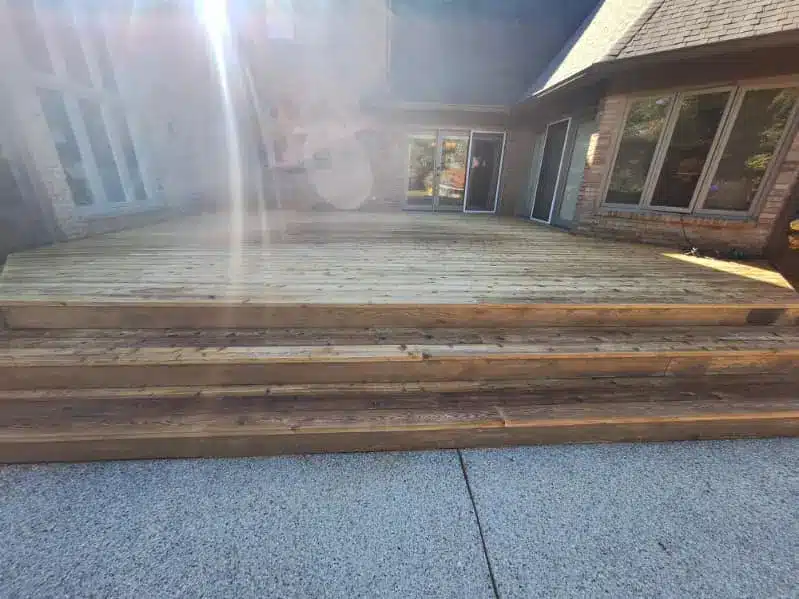
  • Strip the old finish. Any existing stain or sealer has to come off. New stain needs to reach bare wood fibers to grip. This is the step most DIYers underestimate.
  • Clean and brighten. A deck wash removes mildew, grey oxidation, and embedded grime. A wood brightener evens out the tone afterward.
  • Let it dry completely. Wood needs to be genuinely dry — usually 2–3 dry days after washing. Stain over damp wood and it will not penetrate.
  • Sand the rough spots. Knock down splinters and raised grain so the stain absorbs evenly.
  • Pick your stain type (more on this below) and check the forecast — you want a dry window, ideally 50–85°F, with no rain expected for at least 24 hours.
  • Apply thin, even coats with a brush, roller, or pad, working a few boards at a time and wiping back any excess so it doesn't get tacky.
  • Wait out the cure. Light foot traffic after 24 hours; furniture and full use after a few days.
Bare wood deck surface stripped and ready for DIY staining in Indianapolis
Bare, stripped boards — the only surface stain will actually grip to.

The stain types — and how long each really lasts

"Deck stain" isn't one product. The three categories protect very differently, and the more see-through the stain, the faster it fades:

  • Transparent stain — barely any pigment, shows full wood grain. Lasts about 1–2 years outdoors before it needs redoing.
  • Semi-transparent stain — moderate pigment, still shows grain. Lasts about 2–3 years.
  • Semi-solid stain — heavier pigment that mostly masks the grain while keeping some texture. Lasts about 3–4 years.
  • Solid stain — heavy pigment that hides the grain like a thin paint. Lasts 3–5 years, but when it goes it peels in sheets and has to be fully stripped.

Water-based vs. oil-based

You'll also pick a base, and it changes how the deck looks and how you work:

  • Water-based — dries fast, low odor, soap-and-water cleanup, holds color well. Sits closer to the surface.
  • Oil-based — penetrates a little deeper for a richer initial look and can wear better in tough spots, but it's slower to dry, higher in odor and VOCs, and harder to clean up.

It's a real choice for the finish you'll live with — but it doesn't change the fundamental thing all four stain types share: they're a maintenance cycle, not a one-time job. The pigment and the surface film do the protecting, and both break down on a clock. That clock runs faster in Central Indiana than almost anywhere.

Want to see what your deck could look like first?

Play with real stain colors on our deck and fence staining page before you commit to a can.

Try the Color Picker →

Why a DIY stain won't last an Indiana winter

Central Indiana is one of the harshest climates in the country for outdoor wood, and four forces gang up on a stained deck:

  • Freeze-thaw cycling — the Indianapolis area sees dozens of freeze-thaw swings every winter. Each cycle pulls moisture into and out of the wood, and the surface film cracks and lifts as the boards move. (More on local winter conditions from NWS Indianapolis.)
  • Road-salt mist — salt vapor carries onto deck boards near driveways and walkways and accelerates fiber breakdown.
  • Summer UV — Indiana summer sun oxidizes stain pigments. South-facing decks can fade visibly within a single season.
  • Humidity swings — bone-dry January, muggy July. The film expands and contracts until it checks, cracks, and peels.

All four attack the film. As long as your protection sits on top of the wood, the Indiana climate has something to chew on.
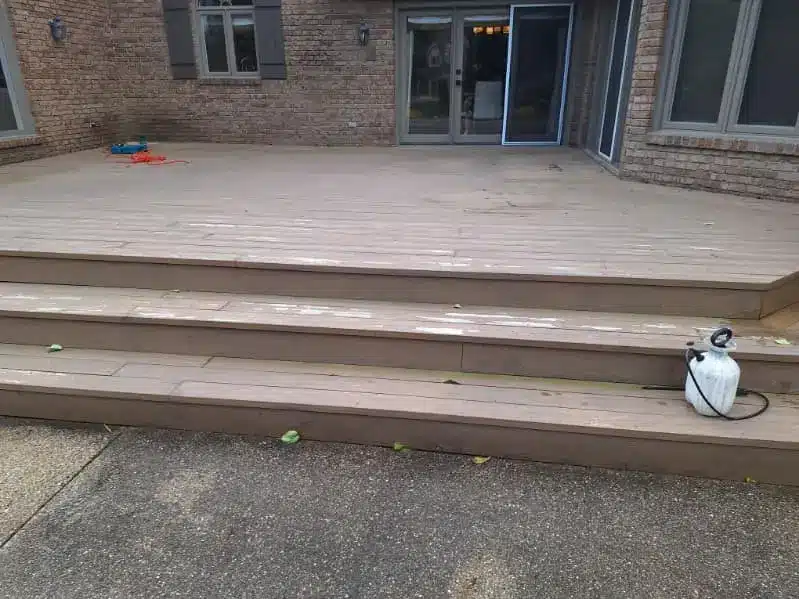
Pressure washing a weathered Indianapolis deck to strip failed stain before refinishing
The reality of the cycle: strip, wash, and start over every couple of years.

The mistakes that make DIY deck staining fail early

If a DIY deck looks bad within a year, it's almost always one of these:

  • Staining damp wood. The single most common failure. If water darkens the boards instead of soaking in, the wood is too wet — and so is the stain that lands on it.
  • Skipping the strip. New stain over old finish has nothing to bond to. It sits on top and sheds.
  • Over-applying. A thick coat doesn't penetrate — it pools, stays tacky, and peels first.
  • Wrong weather window. Staining in direct midday heat (flash-drying) or before rain (washout) ruins the bond.
  • Ignoring the climate. A product rated for mild regions just isn't built for 60-plus freeze-thaw cycles a winter.

DIY vs. hiring a pro — and the option most people don't know about

Done right, a DIY stain is a real way to change your deck's color for a season or two. The honest trade-offs: a full weekend (or two with stripping), the cost of stripper, brightener, stain, and tools, and a near-certain re-do within a few years. That's fine if you enjoy the project. It's frustrating if you were hoping to do it once.

Here's the part the tutorials leave out. Color and longevity are two different jobs:

  • If you want color, stain is the right tool. Our deck and fence staining service does exactly this, with colors you can preview before you commit.
  • If you want it to last, the answer isn't a better stain — it's a penetrating sealer. Our penetrating wood sealer bonds inside the wood fibers rather than forming a surface film, so there's nothing for freeze-thaw, salt, or UV to peel off. That penetrating wood sealer is backed by a 25-year product guarantee — the stain itself isn't covered by that guarantee, because the lifespan comes from the sealer, not the color.

That's why a lot of Central Indiana homeowners do both: stain for the look they want, then seal for the decades they don't want to think about it. If you're weighing the two, our breakdown of deck and fence sealing covers how the penetrating approach differs from a surface coat.
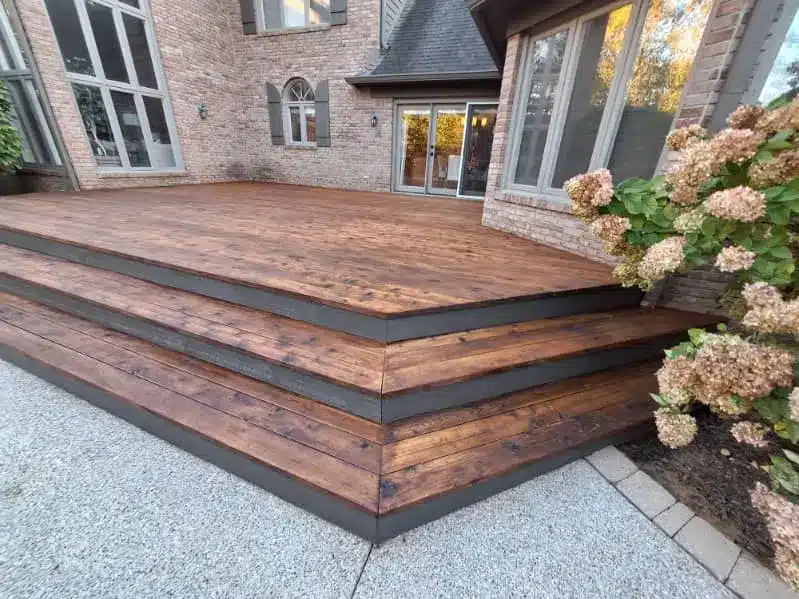
Freshly stained and sealed wood deck with a rich walnut tone at a Central Indiana home
Stain for the look, penetrating seal for the lifespan — the combo most pros recommend in Indiana.

DIY deck staining FAQs

Can I stain my deck myself?

Yes — it's a doable DIY project if you strip the old finish, clean and dry the wood fully, and apply thin coats in the right weather window. Just go in knowing that any stain is a surface treatment, so plan on redoing it every 1–3 years in Indiana's climate.

What's the best wood sealer for decks in Indiana?

For longevity, a penetrating sealer beats any surface-film product. Surface coatings crack and peel under freeze-thaw stress, while a penetrating wood sealer bonds inside the fibers so there's no film to fail. That's the approach we use, and it's why our penetrating wood sealer carries a 25-year product guarantee.

How long does deck stain last in Indiana?

Roughly 1–2 years for transparent, 2–3 for semi-transparent, 3–4 for semi-solid, and 3–5 years for solid stain (solid stains peel worst when they go). Indiana's freeze-thaw cycling, road salt, and UV all shorten those windows compared to milder climates.

Is permanent deck sealing real, or just marketing?

It's real. A penetrating silicate sealer chemically bonds within the wood fibers rather than forming a coat on top, so there's no surface film to break down. You can still damage the wood mechanically, but the sealer itself doesn't peel, flake, or wash off.

Can you stain a deck and then seal it?

Yes, and many homeowners do exactly that. The stain gives you the color; the penetrating sealer is applied after the stain fully cures and provides the long-term protection. You get the look you chose plus a lifespan a stain alone can't deliver.

What does it cost to have a deck professionally stained or sealed?

It depends on the deck's size and condition, with a $1,200 project minimum. The best way to get a real number is a free on-site estimate — call (317) 548-2002 or request a quick quote and we'll walk through your options.

Ready to stop re-staining every couple of years?

Stain for the look, penetrating-seal for the lifespan. We'll walk through both at a free, no-pressure estimate — and tell you straight which one makes sense for your deck.


Seraphinite AcceleratorOptimized by Seraphinite Accelerator
Turns on site high speed to be attractive for people and search engines.