




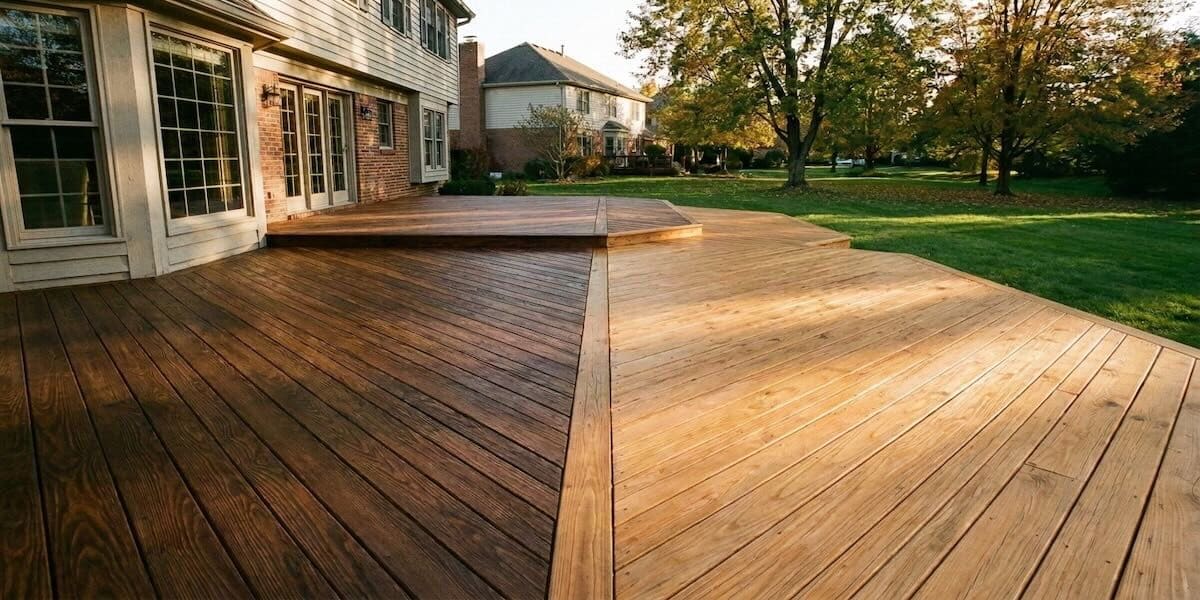
Deck staining adds color but only lasts 1–3 years before it fades, peels, or needs to be re-stripped and re-applied. Deck sealing — specifically penetrating silicate sealing — bonds inside the wood and is permanent. If you want color, stain it. If you want it to last decades without re-doing it, seal it. Many Indianapolis homeowners do both: stain for the look, seal for the lifespan.
The deck staining vs deck sealing question comes up at almost every estimate we run in Indianapolis — and the answer is rarely what homeowners expect. The pros and cons get blurred together online, and most articles you’ll find were written by paint companies that sell stain. So here’s the actual difference — from a Central Indiana sealing crew that does both.
By the end of this guide, you’ll know:
- What deck staining actually does (and doesn’t do)
- What deck sealing actually does (and how it differs from stain)
- Which one lasts longer in Indiana’s freeze-thaw climate
- Whether “permanent deck sealing” is real or marketing hype
- Cost over 25 years for each option
- What to look for in the best wood sealer for decks
What Deck Staining Actually Is
A deck stain is a pigmented liquid that soaks slightly into the top layer of wood and leaves a colored film on the surface. There are three common categories:
- Transparent stain — minimal pigment, shows wood grain. Lasts 1–2 years outdoors.
- Semi-transparent stain — moderate pigment, shows some grain. Lasts 2–3 years outdoors.
- Solid stain — heavy pigment, hides the grain like a thin paint. Lasts 3–5 years but peels worse.
Stain is great at one thing: changing the color of the wood. The downside is that the surface film does most of the protection work, and that film breaks down. UV cracks the pigments, water gets underneath, and Indiana’s freeze-thaw cycle lifts the film right off the boards. That’s why staining is a maintenance cycle, not a one-time project.
What Deck Sealing Actually Is
A deck sealer is a clear (or lightly tinted) protective product applied to the wood. But not all sealers work the same way — and this is where most articles online get the technology wrong.
Surface-film sealers (the kind you find at home improvement stores)
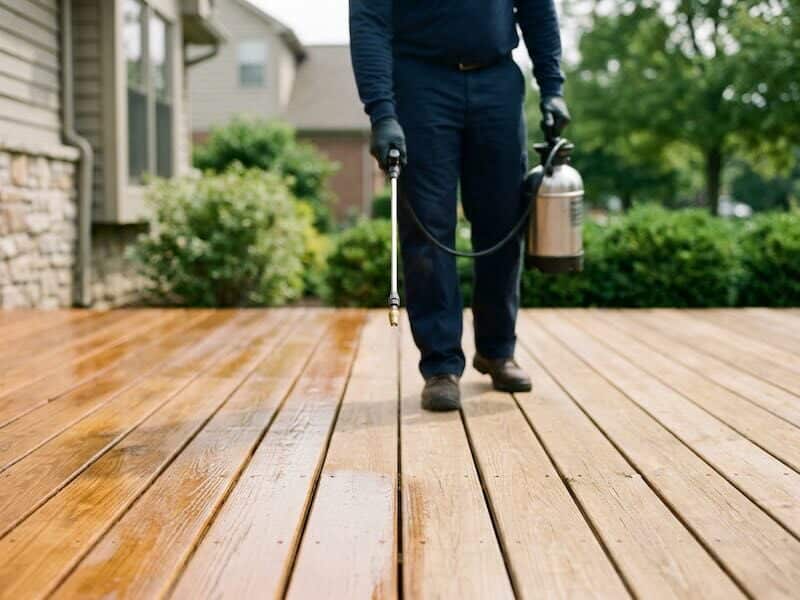
These are usually polyurethane, acrylic, or solvent-based clear coats. They form a film on top of the wood, similar to a stain but without the color. They protect for 1–2 years and then have to be stripped and re-applied. If you’ve heard “deck sealers don’t last,” this is probably what someone meant.
Penetrating silicate sealers (what we use)
This is a fundamentally different technology. A polymerized silicate sealer doesn’t sit on the surface — it carries silicates deep into the wood fibers, where they react with the lignin, cellulose, and atmospheric moisture. The reaction converts to an insoluble silica network bonded inside the wood. This process is called silification, and it’s the same chemistry used to preserve archaeological wood and ancient timbers.
Once the wood is mineralized, there’s no surface film to break down. The protection is part of the wood itself. That’s what makes permanent deck sealing real — it’s not marketing, it’s a different category of product. Read more about how our wood sealing process works.
Deck Staining vs Deck Sealing: The Honest Side-by-Side
Here’s how they actually compare on the things that matter:
| Feature | Deck Staining | Deck Sealing |
|---|---|---|
| How it works | Adds color and a surface film | Penetrates and bonds inside the wood |
| Lifespan | 1–3 years before fade or peel | Permanent — won’t peel or flake |
| Color change | Yes — wide range of tones | Optional — can be paired with stain |
| UV protection | Pigments fade over time | Mineralized fibers resist UV breakdown |
| Breathability | Film traps moisture under surface | Fully breathable — no trapped humidity |
| Re-application | Strip and re-stain every 1–3 years | One-time application |
| Cost over 25 years | Higher (multiple applications) | Lower (single application + warranty) |
| Best for | Homeowners who want color flexibility | Long-term protection without maintenance |
Why Indiana Weather Eats Decks Faster Than Most States
Central Indiana is one of the harshest climates in the country for outdoor wood — which is why the deck staining vs deck sealing decision matters more here than in most parts of the country. Here’s why:
- Freeze-thaw cycling — Indianapolis averages 60+ freeze-thaw cycles per winter. Every cycle pulls water in and out of unprotected wood, splitting the fibers.
- Salt mist — Road salt vapor reaches deck boards near driveways and walkways, accelerating wood fiber breakdown.
- Summer UV — Indiana summers hit UV indexes of 9–10. Stain pigments oxidize and fade visibly within one season on south-facing decks.
- Humidity swings — 30% relative humidity in January, 80%+ in July. Surface films expand and contract until they crack and peel.
All four of those failure modes attack a stained deck. A penetrating sealer mineralizes the fibers themselves — none of those forces have a film to break down.
The 25-Year Cost Comparison
Here’s where the deck staining vs deck sealing math gets honest. A typical 400 sq ft Indianapolis deck:
Staining route
- Initial stain: $1,500–$2,500
- Re-stain every 2–3 years (strip + re-stain): $1,200–$2,000 each time
- 8–12 re-applications over 25 years
- Total: $11,000–$26,500
Penetrating sealing route
- One-time penetrating sealer application: $3,500–$5,500
- No reapplication required
- Total: $3,500–$5,500
Even at the high end, sealing costs less than half of staining over the life of the deck — and your weekends stay yours.
Deck Staining vs Deck Sealing: How to Choose the Right One
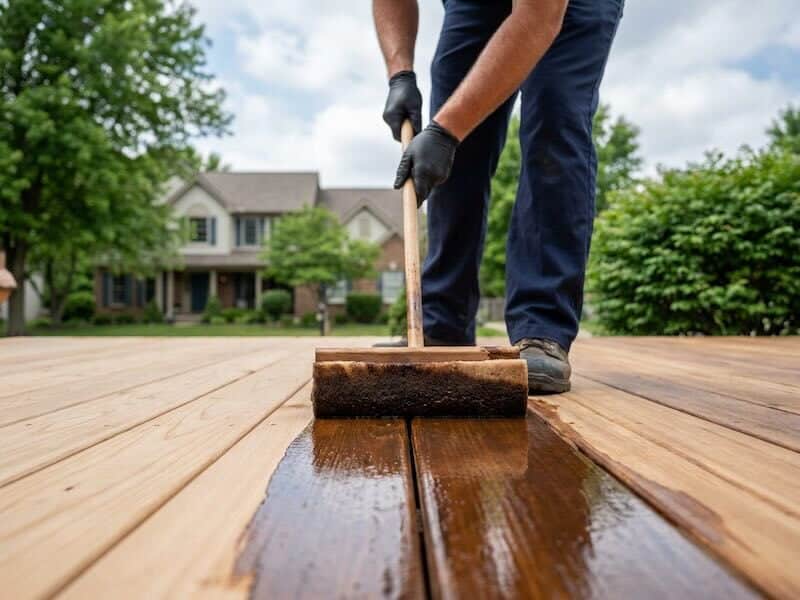
If you’re shopping for a deck sealer in Indianapolis, here are the five criteria that actually matter:
1. Penetration, not film formation
Ask: “Does this sealer form a film on the surface, or does it bond inside the wood?” If it forms a film, it will peel within 1–3 years. Penetrating sealers won’t.
2. Breathability
Wood needs to release internal moisture or it rots from the inside. A breathable, mineralized sealer lets moisture out. A surface film traps it in.
3. UV resistance
UV breaks down pigments and most polymers. Silicate-based sealers resist UV because the protective network is mineral, not organic.
4. Warranty length
If a sealer manufacturer offers a 1-year warranty, that tells you something. Our penetrating wood sealer is backed by a 25-year product guarantee — the longest in the industry.
5. VOC and pet safety
Water-based, low-VOC sealers cure clean and won’t off-gas through the season. If you have kids or pets, this matters.
Deck Staining and Sealing Across Central Indiana
We seal and stain decks across all of Central Indiana, but here’s where we work most:
Carmel
Carmel’s mature neighborhoods — particularly homes in Cool Creek, West Carmel, and Village of WestClay — have deck stock from the early 2000s that’s now well past its first re-stain cycle. We’re seeing strong demand for permanent sealing on these decks, since the homeowners are tired of the maintenance loop.
Fishers
Geist-area waterfront homes get extra UV exposure from open lake reflection. Penetrating sealing performs especially well here, since there’s no film to fade off.
Noblesville
Noblesville’s newer construction (Promise Road, 146th Street corridor) often comes with builder-grade pressure-treated decks that benefit massively from being sealed before the first winter.
Zionsville
Older Zionsville properties with cedar decks and pergolas — penetrating sealing protects the natural cedar tone without the gray weathering most homeowners are fighting.